

Many years ago, when clients called me about a cyberattack, the problem usually had a name I could say in one breath: a denial-of-service attack, or DoS. A website, a payment gateway or a trading platform was flooded with so much junk traffic that legitimate customers could not get in. When the flood came from thousands of hijacked machines at once, we called it a distributed denial-of-service attack, or DDoS. It was brute force. It was loud, it was visible, and the question was mostly how long the lights would stay off and who was behind it.
Today the calls sound different. The attacker may not break anything at all. An AI system can map a company’s exposed systems, write a convincing message in the CEO’s own style, and clone a voice or even a face for a live video call with the finance team. Several of these steps are chained together in layers: reconnaissance, impersonation, access, then theft, each stage faster and cheaper than it was five years ago. Classic social engineering relied on a stranger’s clumsy e-mail. Avatar personification replaces it with a colleague you believe you can see and hear.
Nobody Is Immune
If there is one lesson from recent years, it is that size, sector and geography offer no protection. Consider the range of victims that have made the news:
- Canadian law firms, custodians of some of the most sensitive client information there is, have been targeted by ransomware and data-theft groups.
- Large crypto platforms and fintechs, whose entire business is moving value at digital speed, have suffered breaches involving customer data and funds.
- Refrigeration and other connected equipment in European supermarkets and homes has been caught up in attacks, a reminder that everyday devices are also computers.
- The control systems of commercial ports, the choke points of global trade, have been disrupted by cyber incidents.
- On 1 and 2 November 2026, false nuclear, chemical and radiation alerts were reportedly pushed through civilian emergency-alert apps in both Ukraine and Russia. Responsibility claims by hacktivist groups remain unverified, but the episode shows how cyber tools can be aimed at fear itself.
These are different victims with different motives, but one pattern: the attacker looks for the weakest link, wherever it is.
The Same Tool, Different Hands
There is an old metaphor in my profession. A scalpel in the hands of a surgeon saves a life; in the hands of a criminal, it takes one. The blade is identical. The intent is what changes the outcome.
Artificial intelligence is that blade. Anthropic has said that its Claude Mythos Preview model, shared with a small group of trusted organisations through Project Glasswing, identified thousands of previously unknown software vulnerabilities, which were communicated to the affected parties so they could be fixed. OpenAI has likewise released a cyber-specialised model. In other words, the largest AI developers are using these tools to find the holes before the criminals do.
The uncomfortable corollary is that the same capabilities can be used to find and exploit those weaknesses. Europol’s 2026 assessment of internet-organised crime describes a widening ‘velocity gap’: criminals adopt new technology faster than investigators and institutions can respond. AI can be used to explore your defences or to protect them. The question is who is using it first.
What the Numbers Say
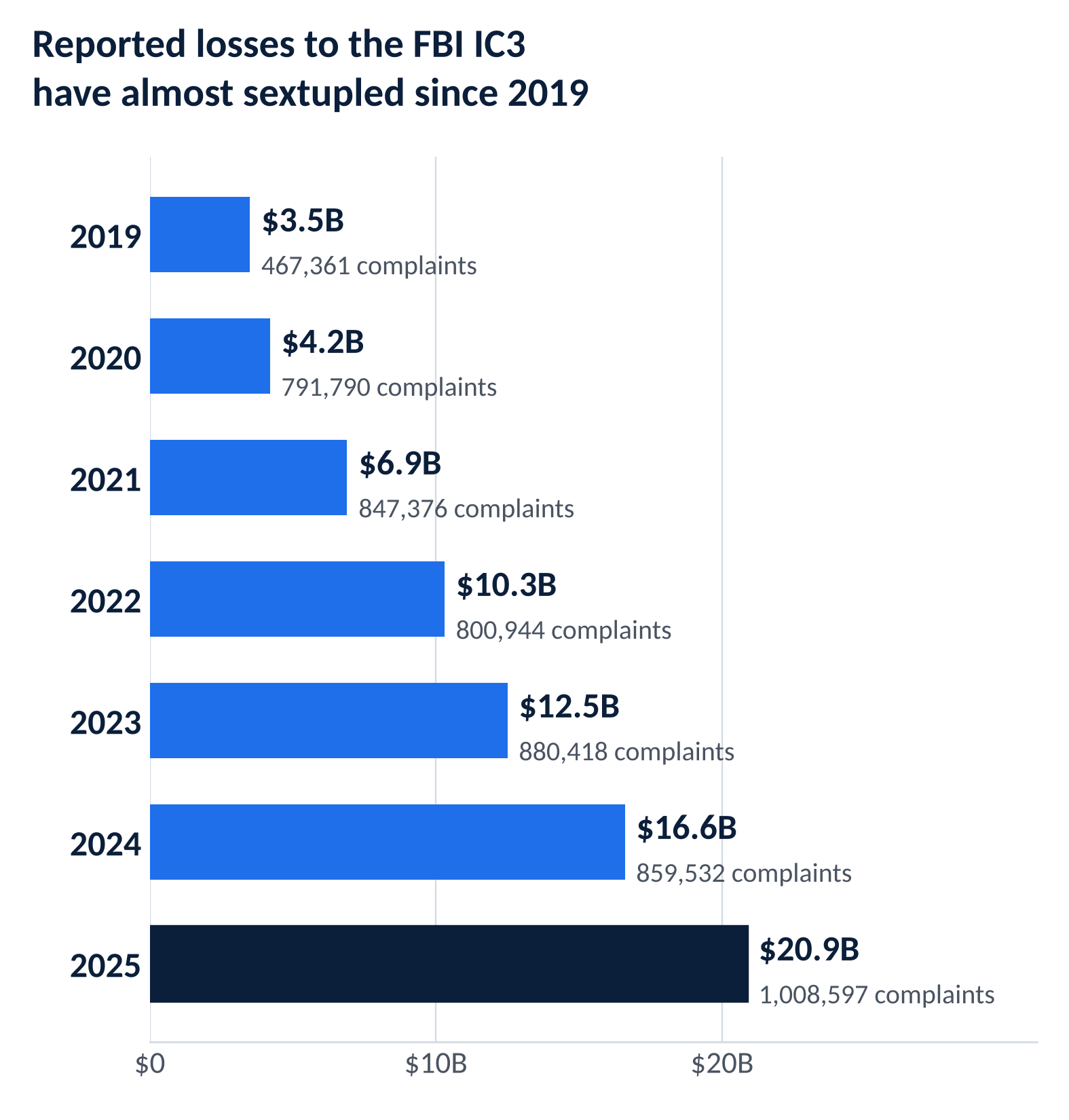
The most authoritative public series on cyber-enabled crime comes from the FBI’s Internet Crime Complaint Center (IC3). Its figures cover complaints made to the FBI, mostly by US victims, so they understate the global picture, but their direction is unambiguous. Reported losses rose from $3.5 billion in 2019 to $20.9 billion in 2025, while complaints more than doubled to just over one million (Exhibit 1).
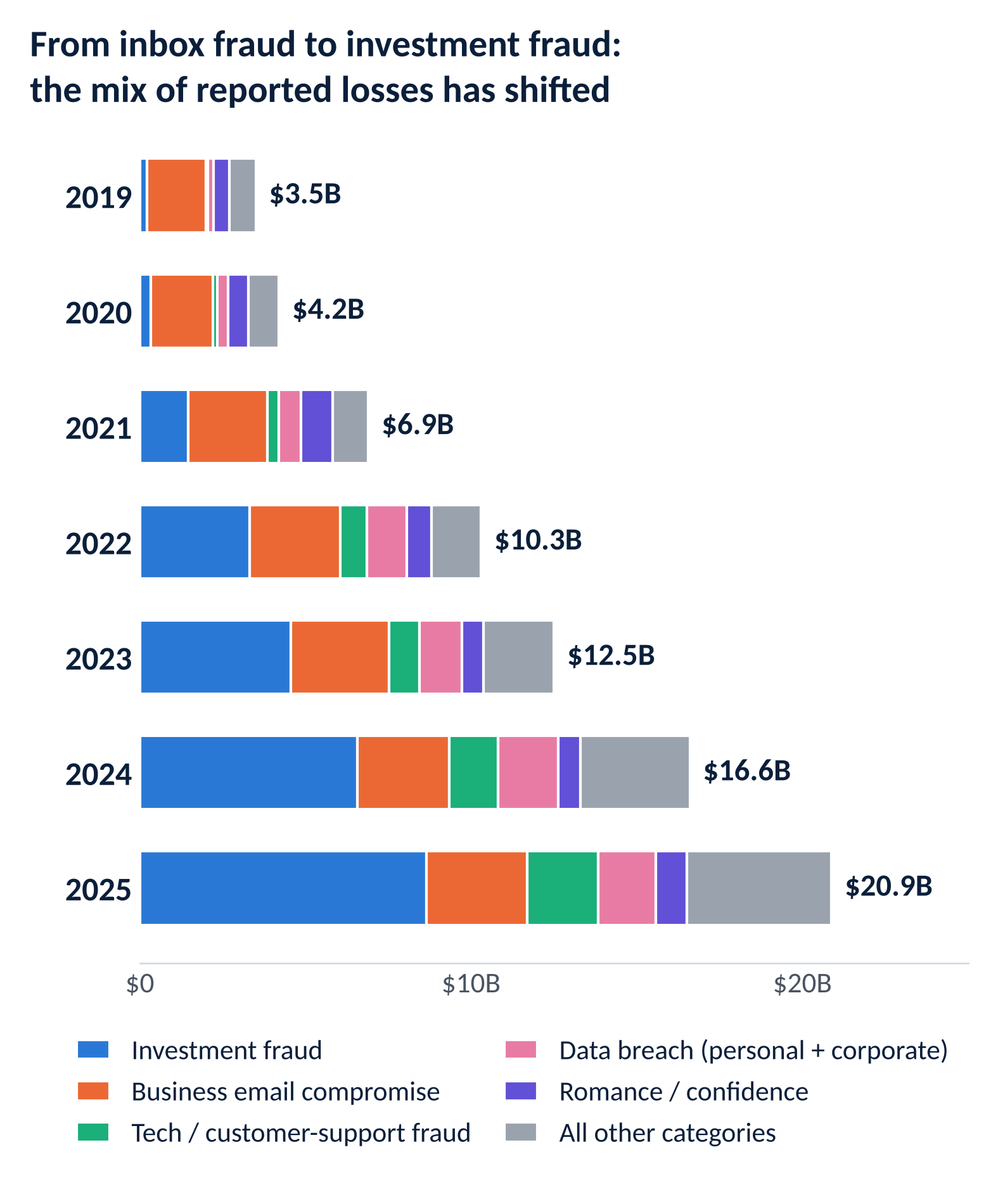
The mix of crime has changed as much as the volume. In 2019 the largest category was business email compromise, at $1.8 billion. By 2025 investment fraud, often combined with cryptocurrency and, increasingly, with AI-generated content, had grown to $8.6 billion, around 41% of all reported losses. Technical-support and customer-support fraud grew from $54 million to $2.1 billion over the same period (Exhibit 2). IC3 changed its category definitions over the years, so Exhibit 2 harmonises them and should be read as a trend rather than an exact ledger.
Two further facts from the 2025 report deserve attention. First, cyber-enabled fraud accounted for roughly $17.7 billion, about 85% of all reported losses. Second, IC3 recorded cryptocurrency-related losses of $11.4 billion and, for the first time, flagged AI-related complaints: 22,364 complaints and $893 million, most of it investment fraud.
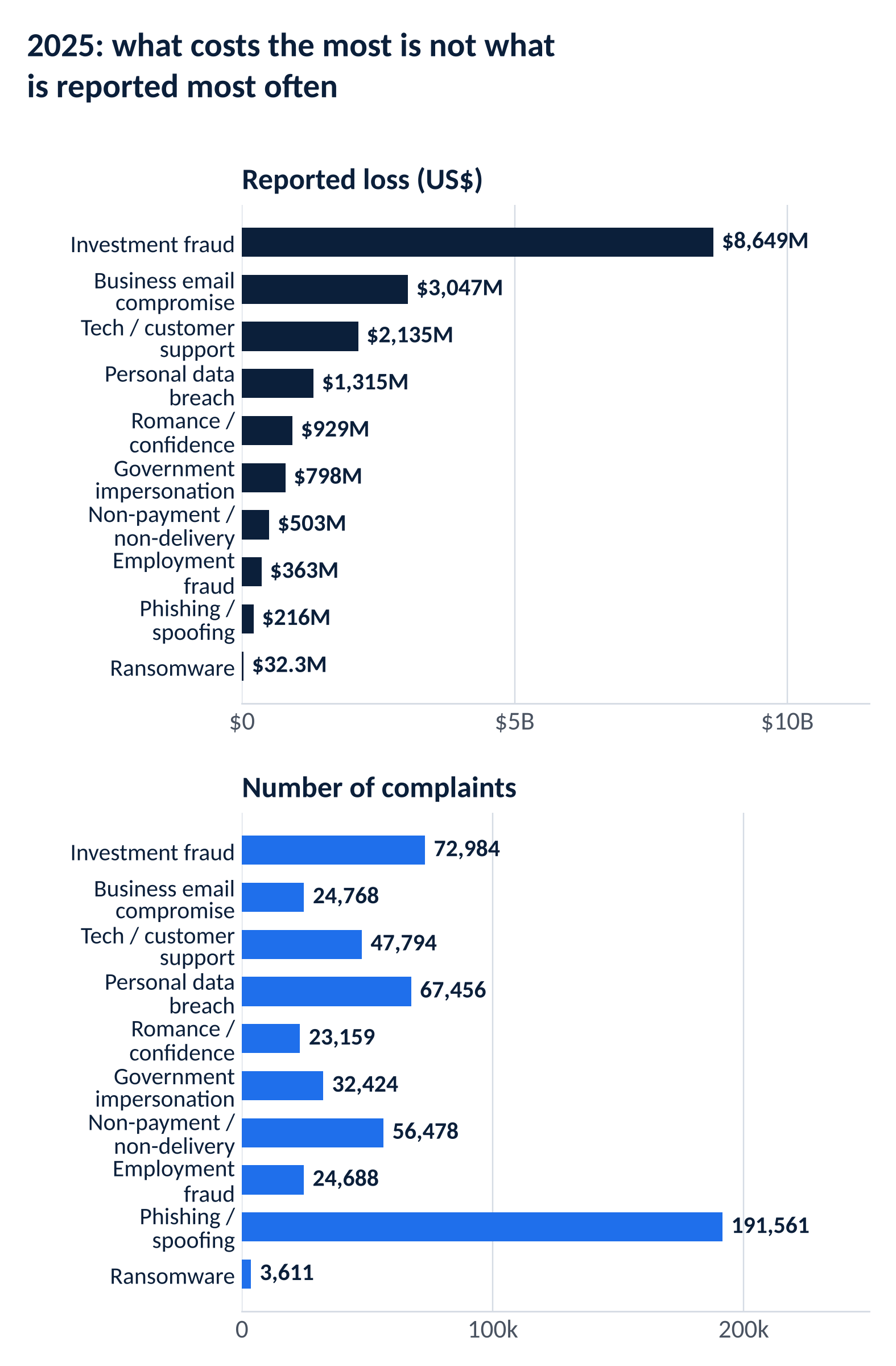
Exhibit 3 shows why volume and value should never be confused. Phishing and spoofing generated the most complaints (191,561) but relatively modest reported losses ($216 million). Investment fraud generated about a third as many complaints (72,984) and forty times the loss. Ransomware, the crime that dominates headlines, appears small in IC3 data, with 3,611 complaints and $32 million, largely because many victims pay or settle without reporting to law enforcement.
The technical entry points are shifting too. Verizon’s 2026 Data Breach Investigations Report found that exploitation of vulnerabilities was the initial access route in 31% of breaches, up from 20%, while stolen credentials fell from 22% to 13%. Third-party involvement rose to 48% of breaches. Attackers are moving faster on unpatched flaws, and they are reaching large companies through their suppliers.
How Investigations Have Changed
Early in my career, a forensic investigation typically began with a physical device: seize it, copy the disk, verify the hash, analyse the files. That discipline still matters, but today much of the evidence never sits on a single device. It lives in cloud services, identity platforms, messaging apps, encrypted phones, volatile memory and public blockchains (Exhibit 4).
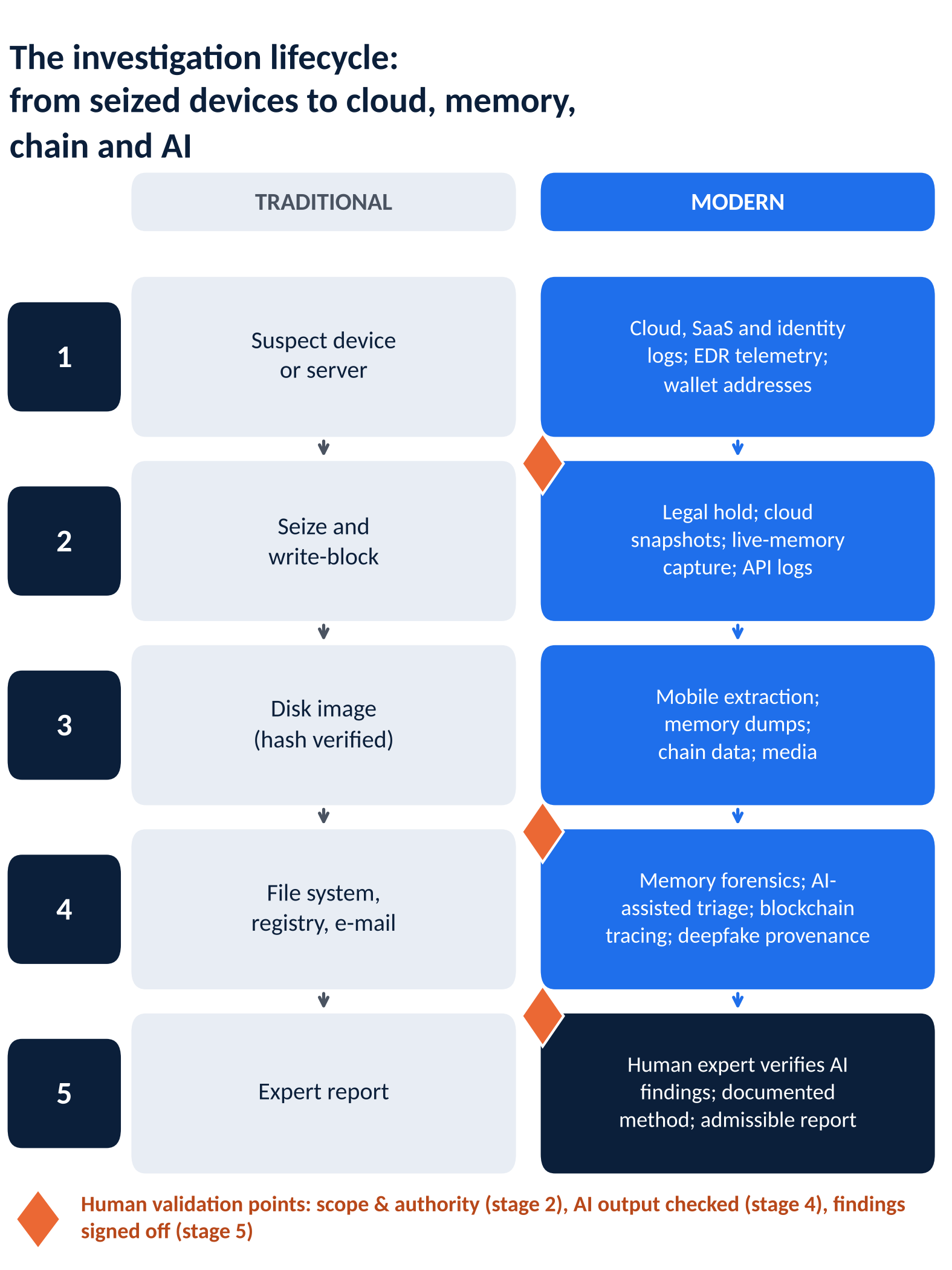
Modern practice combines several techniques:
- Cloud and identity forensics. Reconstructing an intrusion from authentication, SaaS and API logs, often before any server is touched.
- Memory forensics. Capturing and analysing live memory, with tools such as Volatility, to find malware and credentials that never reach disk.
- Mobile forensics. Extracting data from phones and apps while contending with encryption and anti-forensic techniques.
- Blockchain tracing. Following stolen funds across wallets, exchanges and mixers to identify where assets can be frozen or recovered.
- AI-assisted triage. Using machine learning to sift very large data sets quickly, while recognising its limits: hallucination, explainability and admissibility.
- Deepfake examination. Detection tools are unreliable on their own; provenance, metadata and a defensible chain of custody carry more weight.
The common thread is that AI accelerates the work, but a qualified human must validate it. A finding that cannot be explained to a judge, a regulator or a board is not evidence.
What You Can Do, and How HP Can Help
Prevention is far cheaper than response, and most organisations can do more than they think. A practical starting point is to know your exposure, test your controls, prepare your response and examine your suppliers. At Holder Partners, our cyber crime unit works with clients on both sides of the line:
- Compliance review and prevention. Assessing governance, controls and third-party risk against applicable regulations and standards; reviewing incident-response and crisis plans; and preparing leadership for deepfake-enabled fraud and AI-driven attacks before they happen.
- Cyber-forensics and investigation. Preserving and analysing digital evidence, tracing stolen funds, establishing what happened and who was responsible, and producing findings that stand up to regulators, courts and insurers.
Holder Partners supports clients whose exposure crosses borders, jurisdictions and languages, which is increasingly the norm. If you would like to discuss a compliance review, a readiness assessment or an active incident, I would be glad to hear from you.
Eduardo Sampaio | Managing Director
Sean Lewis | Senior Cybersecurity Analyst
November 2026
Sources
- FBI Internet Crime Complaint Center (IC3), Annual Reports 2019–2025
- Verizon, 2026 Data Breach Investigations Report
- Europol, Internet Organised Crime Threat Assessment (IOCTA) 2026
- Anthropic, Project Glasswing
- IBM/Ponemon, Cost of a Data Breach Report 2026; Chainalysis, 2026 Crypto Crime Report