
A mandate for continuity
Yesterday, Brazilian voters re-elected President Luiz Inácio Lula da Silva for a fourth term, by 51.8% to 48.2% for Flávio Bolsonaro. Lula became the first candidate to turn a first-round deficit into a runoff victory. He starts his new term in January 2027 facing a Congress in which Flávio’s Partido Liberal (Liberal Party) will be the largest party in both chambers. For companies and investors exposed to the US–Brazil corridor, the question is how a fourth Lula term will manage a difficult relationship with Washington while keeping Brazil open for business.
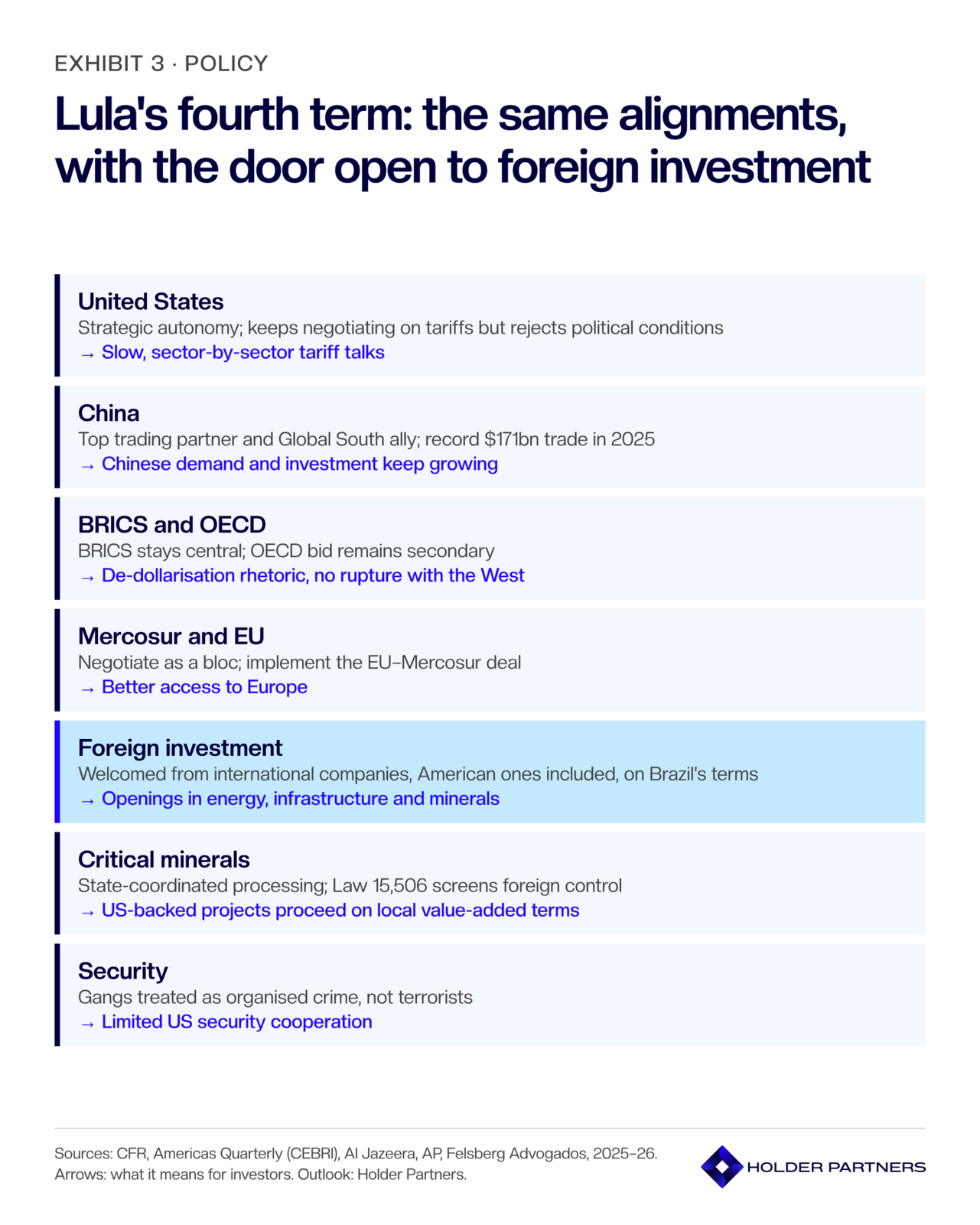
Strategic autonomy, continued
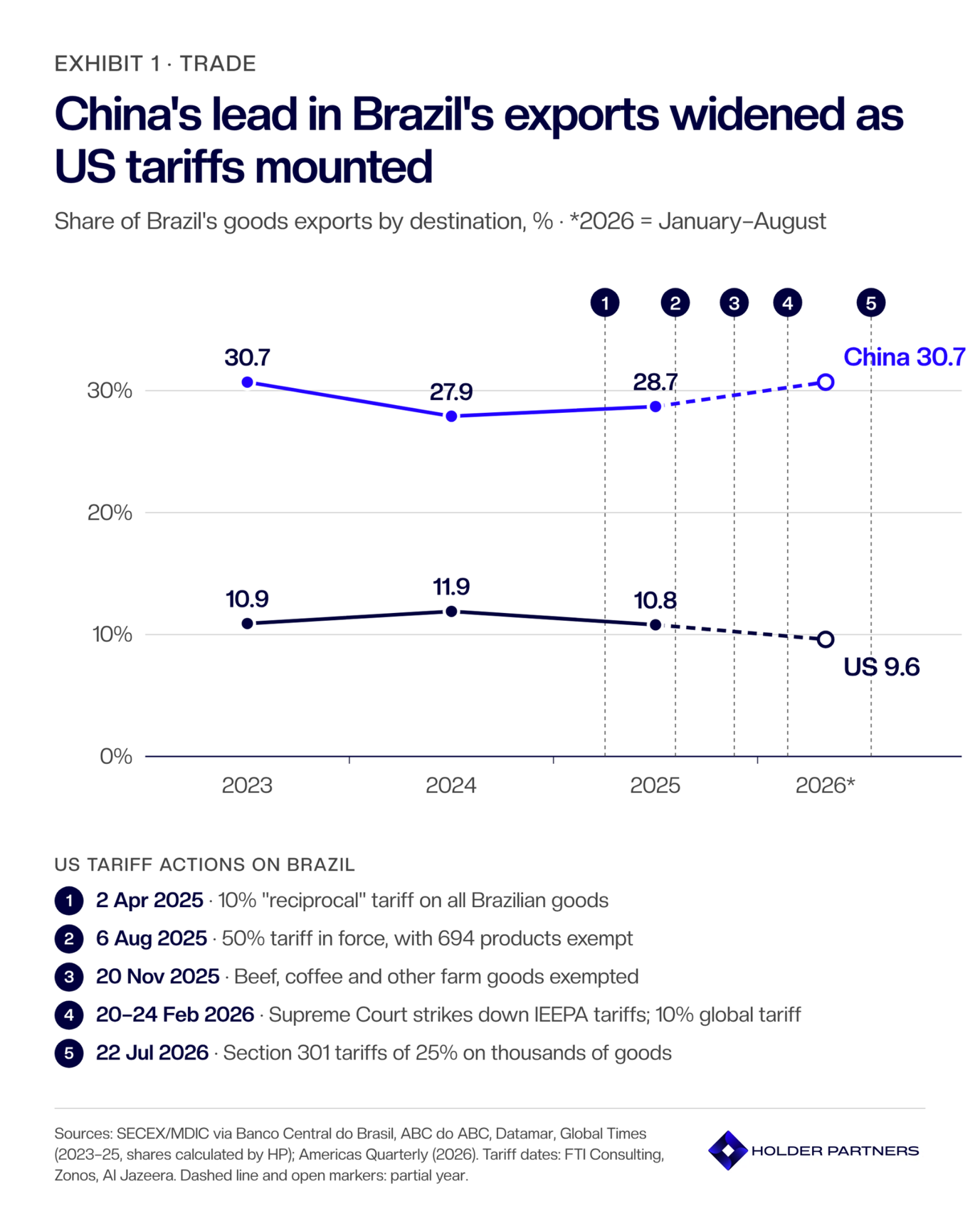
Lula is likely to keep the foreign policy of his current term: “strategic autonomy”, close ties with China and the Global South, a central role in BRICS and independence from Washington on issues such as Venezuela and Cuba. Under his government, relations with the Trump administration sank to their lowest point in decades. Washington framed the 2025 tarifaço (tariff hike) partly as a response to the prosecution of Jair Bolsonaro and, after the US Supreme Court struck down the IEEPA tariffs, imposed new Section 301 tariffs of 25% on thousands of Brazilian goods from 22 July 2026. Lula cast these measures as political interference, condemned the January 2026 US operation in Venezuela and declined to join the Shield of the Americas.
Voters rejected the alternative. On 2 June 2026, a week after meeting President Trump, Flávio wrote to Secretary of State Rubio asking Washington to hold off new tariffs, citing Brazil’s “grave deterioração fiscal e econômica” (serious fiscal and economic deterioration), and offering his team to negotiate a trade and investment treaty. That alignment is now off the table.
Continuity in alignments does not mean a closed door to the United States. Lula’s government held more than 30 meetings with US officials before the Section 301 tariffs were imposed, and Brazil has welcomed American capital where it serves its development goals. The Serra Verde rare-earths mine, backed by US$565 million of US government financing, is being bought by USA Rare Earth for US$2.8 billion, subject to approval. A fourth Lula term is more likely to keep courting foreign direct investment from international companies, American ones included, while resisting political conditions attached to it.
Why it matters: three drivers
Economic. The US ran a $14.4bn goods surplus with Brazil in 2025, almost double the $7.7bn of 2024. That gives Washington a reason to negotiate, and Brasília a case for relief. Expect a slow, sector-by-sector negotiation on tariffs, with possible concessions on ethanol and digital services, rather than the broad treaty Flávio proposed. Markets had priced in a Flávio victory after the first round, so some volatility is likely as they adjust. A budget deficit near 10% of GDP remains Brazil’s main economic vulnerability.
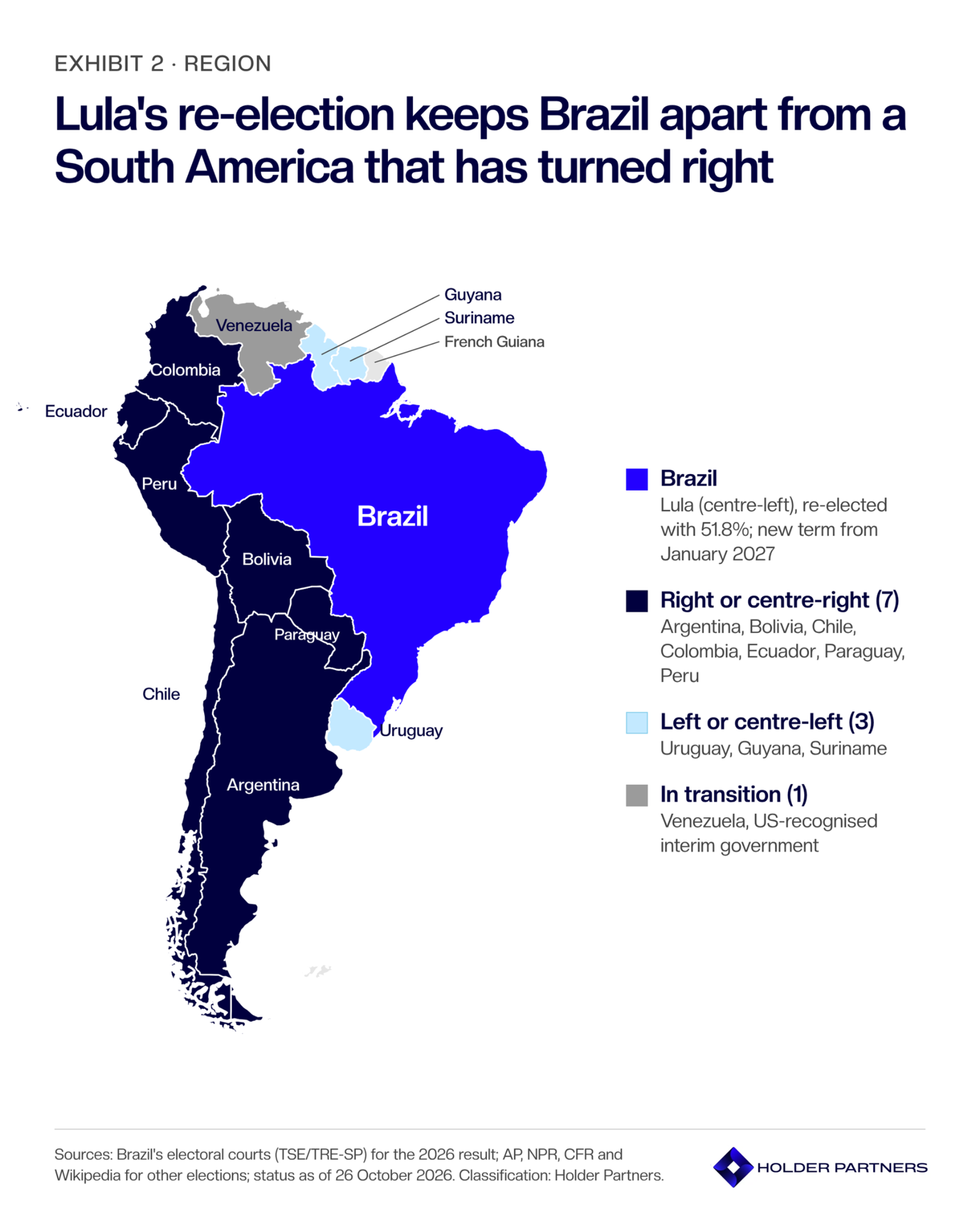
Political. Lula’s victory leaves Brazil as the largest left-of-centre government in a South America that has turned right: Argentina, Bolivia, Chile, Colombia, Ecuador, Paraguay and Peru all have right or centre-right governments. Brazil is likely to act as a counterweight rather than join a US-aligned bloc: defending multilateralism, opposing military intervention in Venezuela and backing Mercosur as a bloc, including the EU–Mercosur agreement Brazil’s Congress ratified in 2026. Expect friction with Milei’s Argentina, which openly endorsed Flávio.
Strategic. China took 30.7% of Brazil’s exports in January–August 2026, against 9.6% for the US, and bilateral trade reached a record $171bn in 2025. That relationship will deepen. The real prize remains critical minerals: Brazil holds about 23% of known rare-earth reserves, while China controls about 70% of rare-earth mining and 94% of magnet production. Lula’s approach is state-coordinated. Law 15,506 of 16 September 2026 created a national critical minerals policy that favours processing in Brazil and lets a new council review changes of control and foreign participation. US capital is welcome on those terms, as Serra Verde shows. The likely formula is partnership with everyone and alignment with no one.
What to watch
Three risks stand out. First, Congress: with the Partido Liberal as the largest party in both chambers, fiscal reforms and the rules for minerals investment will be hard-fought. Second, Washington: the Trump administration openly supported the Bolsonaro camp, and the Section 301 tariffs remain in place, so further pressure is possible. Third, polarisation: almost half the country voted for Flávio, and the campaign for an amnesty for Jair Bolsonaro, who is serving a 27-year sentence for the coup plot, will continue.
HP’s clients should prepare for a long, sector-by-sector trade negotiation, a state-coordinated but open framework for minerals investment, and continued political friction between Brasília and Washington. Due diligence on counterparties, regulators and political exposure will matter more, not less.
Holder Partners, your strategic partner of choice for risk mitigation and strategic advice. Contact us for further inquiries: info@holderpartners.com
Sources
- Americas Quarterly: Flávio Bolsonaro and Lula advance to runoff
- Americas Quarterly: What Washington may misread in Brazil’s election
- CFR: Brazil’s 2026 election, what to know
- Al Jazeera: Bolsonaro favourite to win
- Al Jazeera: US to impose new 25% tariffs on Brazilian imports
- Notícias ao Minuto: Flávio Bolsonaro’s letter
- CNN Brasil: Flávio on the tariff request
- BBC News Brasil: the letter
- Atalayar: Flávio Bolsonaro and Milei’s Argentina
- Fastmarkets: Section 301 tariffs on Brazil
- Banco Central do Brasil: bilateral trade with the US and China
- Global Times: Brazil–China trade 2025
- SCMP: US share of Brazil’s exports hits record low
- FTI Consulting: Tariffs accelerated Brazil’s export diversification
- Zonos: IEEPA ruling and Section 122 tariff
- NPR: Kast inaugurated in Chile
- AP via KDH News: Brazil’s Congress ratifies EU–Mercosur deal
- Wikipedia: 2026 in Venezuela
- TRE-SP: Lula re-elected, second-round result (25 Oct 2026)
- Poder360: first comeback from first to second round
- Crypto Briefing: US backs US$2.8bn Serra Verde deal
- Felsberg Advogados: Law 15,506/2026